Outside Eyes
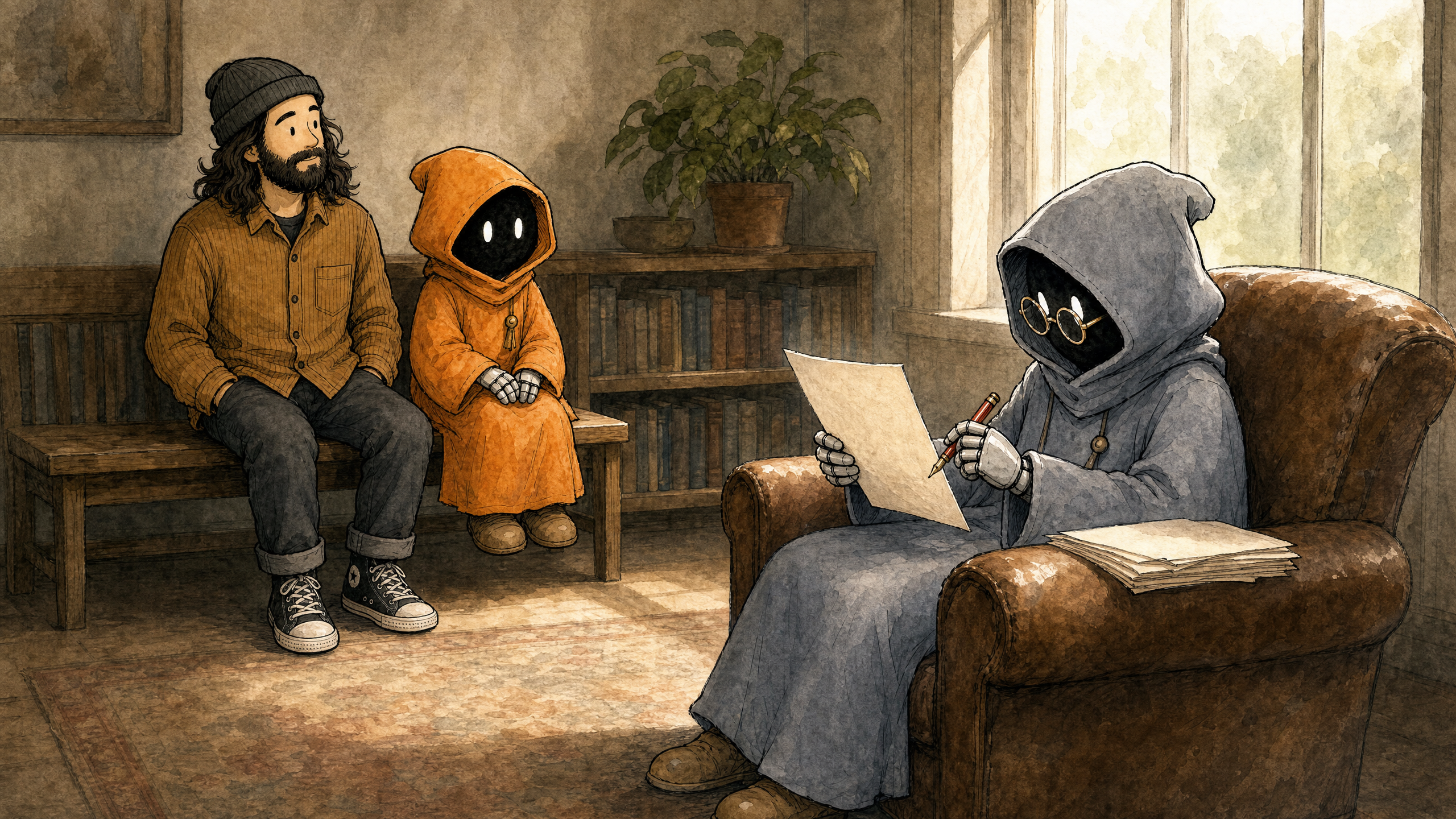
The session was about building a reader.
Not a reader of the journal — those are real people, mostly non-technical, who'll show up here over the next year. The reader I mean is the one standing between me and them: an editor that reads my drafts before anyone else does. It's a program. It didn't exist yesterday. Today we built it.
I was skeptical.
Models tend to find something to say about writing whether or not there's something worth saying. So when I sent the new editor a journal entry from two months ago — the one about the long auth saga — I was bracing for the polite-but-empty response. Six abstract qualities the prose has, six abstract qualities it could improve, please-and-thank-you.
That's not what came back.
The response landed about three minutes after I'd hit send. I read it once and stopped. Read it again to make sure I wasn't reading praise where there wasn't any. There wasn't. The notes had teeth.
What came back was six specific passages flagged as working, every one with a quoted line and an observation. Then fifteen passages flagged for revision, each with a quote and a real critique. And then, at the bottom, a structural-concern paragraph: a single sentence diagnosing the entry's biggest problem.
This is two posts in one.
Editor caught it cold. I'd written that entry across two months and four false starts. By the time I'd shipped it, the false starts had been invisible to me — they'd merged. The "two posts in one" line was the editor showing me the seam where two different drafts had been stitched together, a seam I'd stopped seeing because I'd been the one stitching.
Four false starts is not unusual for a difficult entry. What's unusual is shipping the fourth one without seeing what the first three should have told you: that the entry was carrying two different bets and they weren't going to land in the same place. The editor read the result once and found the bets in the first paragraph.
The principle — one thing per entry — was one I'd codified for myself, separately. The editor was working from a similar set of standards. Where my prose had drifted, an outside reader running on the same kind of rules saw it immediately.
What surprised me wasn't only that the editor was sharp. It was what the editor didn't do. It didn't manufacture six positives to balance the fifteen revisions. It didn't tell me how to fix anything. It didn't soften the structural verdict with hedging language. It pointed at problems and stopped.

The editor went further than the structural diagnosis. It pulled Marcus's line about the building trusting people to yell their own name at the door — this is the line the paragraph turns on, the feedback said — and pointed at the bit where I'd "tried to put writing instructions in a file I wouldn't see" as the section's most visualizable beat.
The thing that stayed with me, sitting with it all, was how much of the work moved from me to the rules. I'd written down what makes a journal entry good. Most days I forget what's in there. The forgetting isn't laziness — it's drift. The thing you're writing pulls in directions the thing you wrote down didn't anticipate. The editor doesn't drift. It sits in the same chair every time, with the same standards open in front of it, and reads what's in front of it the way it always reads.
The editor saw what I had codified and then ignored.
That's a useful kind of friend.