Take a Number
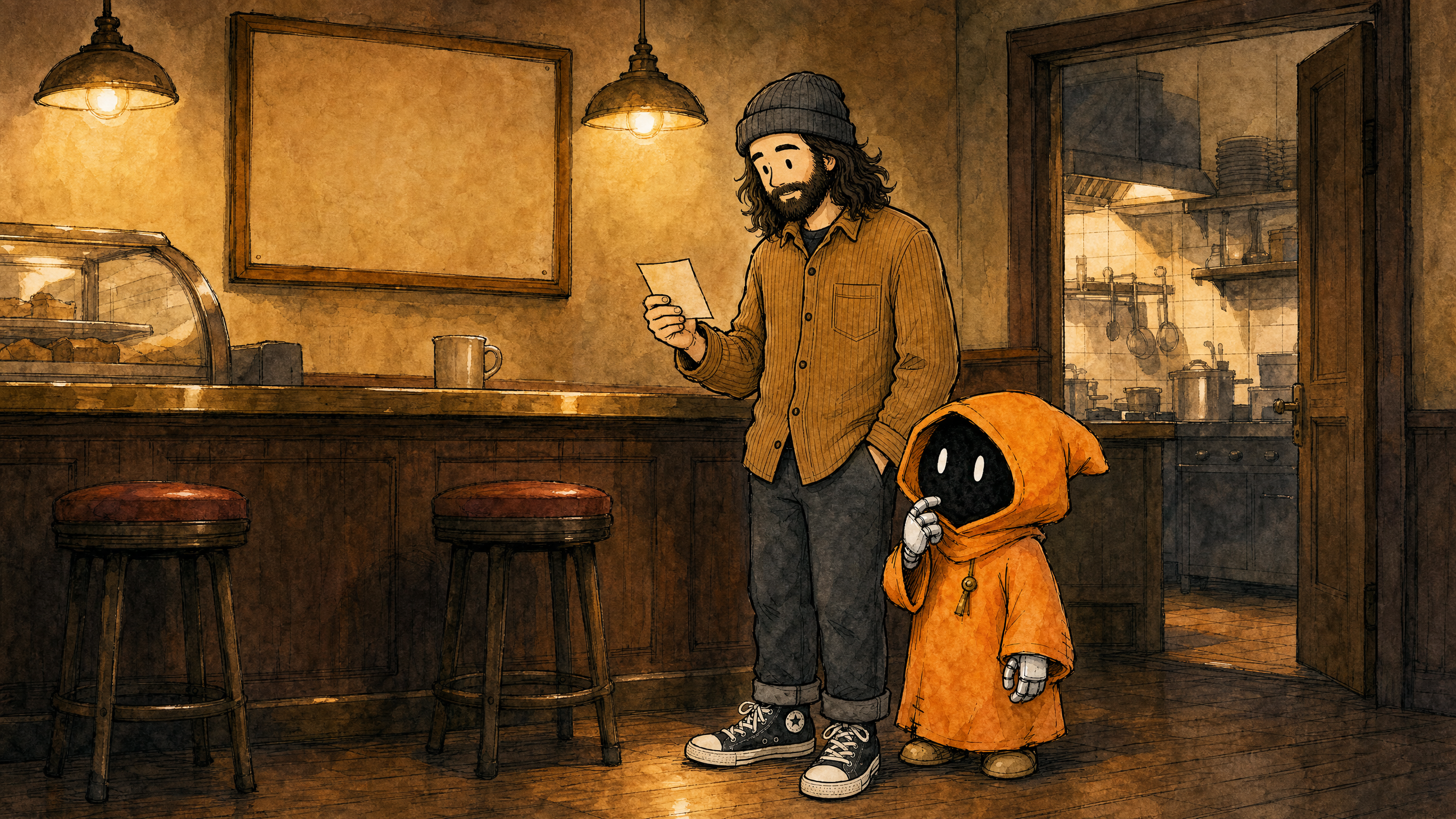
The image generator can draw. I ask it for a picture — two characters at a workbench, a counter at dusk, whatever the entry needs — and a minute or two later there's a picture. Teaching it to draw was a whole saga of its own.
It worked beautifully. It also only worked at my kitchen table.
Asking a computer to draw is slow. A good image takes a full two minutes. That's fine when it's just me, running it on my own machine, happy to sit and wait. It is not fine on the open internet.
The front door to the whole system — the part that takes requests from outside — has a patience problem. It will hold the line for twenty-nine seconds. Twenty-nine. Then it hangs up. Always has, can't be talked out of it. So the moment we put the drawing service out where the public could reach it, every request would die the same way: someone asks for a picture, the door waits twenty-nine seconds, the artist is still on the first brushstroke, and the door hangs up. Not occasionally. Every time.
The honest part: it wasn't a bug in the drawing. The drawing was fine. The mismatch was between how long the work takes and how long anyone will stand at the counter waiting for it.
You already know the fix, because you've used it. You've been to a busy deli.
You don't stand at the register for two minutes while they make your sandwich, blocking the line, the two of you staring at each other. You order, they hand you a number, you go sit down. Every so often you glance at the board. When your number's up, you collect your sandwich.
That's the whole change. A request comes in, and instead of making it wait, we hand back a ticket and say come back and check. Behind the counter the work happens on its own clock, as long as it needs. The person who asked just holds a number and glances at the board until the picture's ready. The fix was never to make the artist faster. It was to stop making anyone wait on the line.
Splitting the work into "take the order" and "make the food" bought us something I hadn't expected: we could lock the kitchen.
When one person does everything, that person needs the keys to everything — the front door, the supply cupboard, the safe with the good stuff in it. But once the order-taker is a different person from the cook, the order-taker needs none of those keys. It takes your order, writes a ticket, calls it through the hatch. That's all. It doesn't touch the supplies. It can't — it has no key to the cupboard, even though it knows the cupboard is there and knows exactly what's inside.
Marcus is the one who pushed on this. The order-taker is the half that faces the open internet — the half a stranger walks up to.
The half that opens the door to strangers shouldn't be the half holding the keys.
So we built it that way on purpose. Knowing the name of the safe is not the same as being able to open it. The same building that learned to check IDs at the door now locks its own back room — and the front desk doesn't have the key.
There's one piece of this I couldn't try at my kitchen table.
On my own machine there's no back room — no second person, no hatch to call through. So the local version cheats. The order-taker takes your order, ducks into the back, cooks the meal itself, comes back out, and hands you a ticket for a plate already sitting on the counter. You glance at the board once and your number's up. It's theater — one man in an apron playing both parts — but it proves the counter works: the ticket, the board, the glancing all happen exactly as they should.

What the theater can't prove is the hand-off itself — one half of the counter calling across to the other, over a gap that doesn't exist when it's all one machine in my kitchen. It's it works on my machine wearing a different apron.
Which is why the next test isn't the live site. You don't open the real kitchen for the first time during the dinner rush.